Banya or sauna? Although both places use heat, steam and high temperature work here in a completely different context. The difference is not just about the number of degrees on the thermometer.
Banya is not simply a "wetter sauna". It is a distinct bathing tradition where steam, the rhythm of heating and cooling, rest, and characteristic leafy branches play a vital role.
In this article, we explain how a banya differs from a Finnish sauna, what the temperature is in a banya, what leafy branches are, and why guidance through the entire process is so important in a bania.
Banya vs sauna — the key differences
Put most simply:
- Finnish sauna = high temperature and dry air
- Banya = lower temperature, higher humidity, and a ritual based on steam and leafy branch work
A typical Finnish sauna operates at temperatures around 80–100°C with relatively low humidity, often around 5–20%. In a banya, the temperature is usually lower, often in the range of 50–70°C, while the humidity is significantly higher. Specific parameters, however, depend on the banya's construction, the stove, the way steam is managed, and the course of the ritual.
| Feature | Banya | Finnish sauna |
|---|---|---|
| Temperature | usually approx. 50–70°C | usually approx. 80–100°C |
| Humidity | high | low |
| Steam | vital element of the process | usually brief splashing of water on stones |
| leafy branches | characteristic element | not part of the tradition |
| Cooling | part of the complete cycle | depends on the facility and sauna style |
| Character | ritual and guidance | heat bath, often in silence |
| Role of the guide | very important in the banya ritual | depends on the type of sauna session |
If you want to see what this difference looks like in practice, we have described it in more detail on the discover the Slavic banya page.
What is the temperature in a banya?
This is one of the most common questions from people hearing about a banya for the first time.
A banya does not have to be very hot to be intense.
In traditional and modern banyas, temperatures are lower than in a classic Finnish sauna, but higher humidity changes how the heat is perceived.
Therefore, the comparison:
"The sauna is 90°C and the banya is only 60°C, so the banya is lighter"
is an oversimplification.
Humid air limits the ability of sweat to evaporate from the skin's surface, causing the body to perceive the heat load differently. Therefore, the temperature on the thermometer does not tell the whole story about the intensity of the session.
In a banya, it is not just the temperature that counts, but also:
- humidity,
- the amount and method of steam delivery,
- air movement,
- position on the bench,
- length of subsequent stages,
- method of cooling,
- the experience of the banya master.
What are leafy branches in a banya?
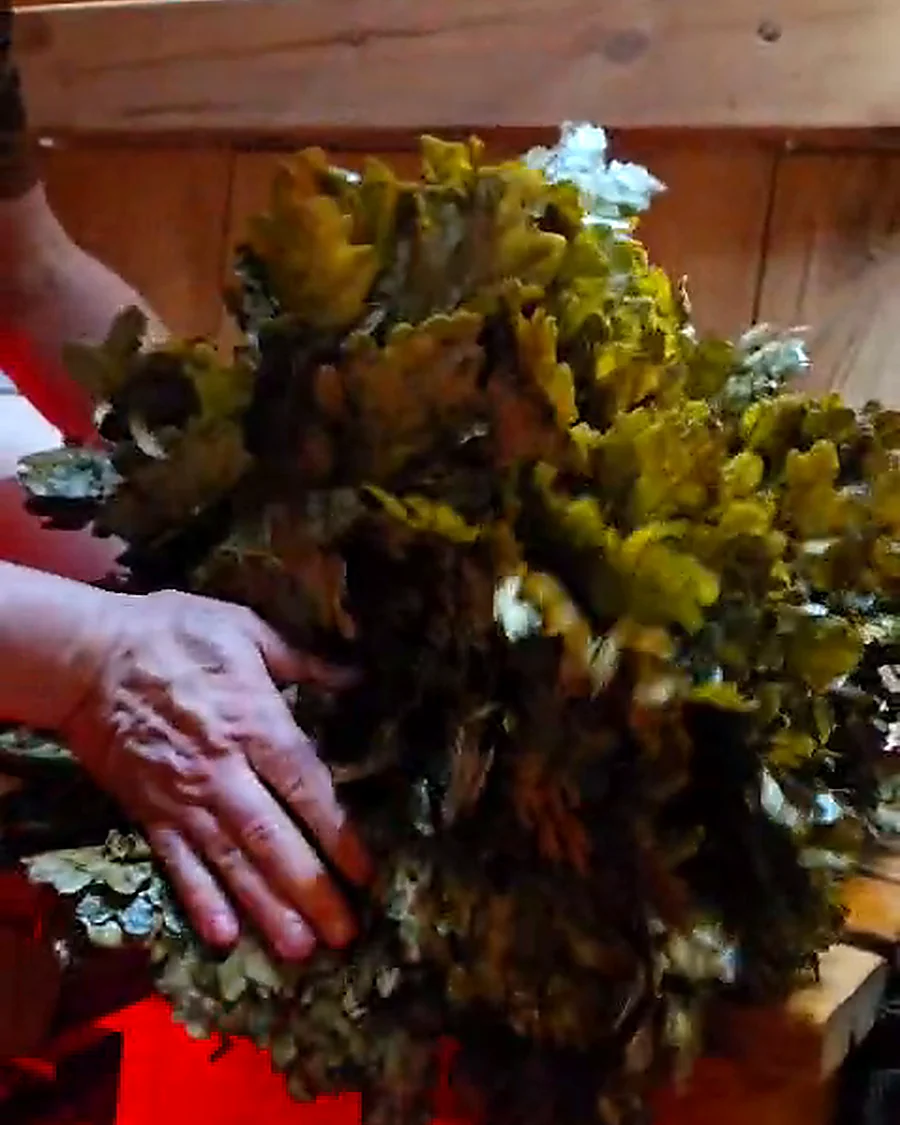
One of the most characteristic elements of a banya are leafy branches.
These are tied bundles of young twigs, most often birch, although other tree species are also used.
leafy branches are not for "beating" for the sake of beating.
In a properly conducted ritual, they are used to work with hot and humid air and for rhythmic contact with the body. Movement with leafy branches can include fanning, gentle touching, tapping, and guiding hot air along the body.
It is the leafy branches that are one of the elements that most distinguish a traditional banya ritual from a regular stay in a sauna.
Why is steam used in a banya?
In a Finnish sauna, the basis is dry heat. Water may be poured onto hot stones, but its effect is usually short-lived.
In a banya, steam is a much more important element of the whole process.
The banya master controls its quantity, distribution method, and timing of delivery. So it's not just about "making a lot of steam".
Good steam is part of the technique.
Its character depends, among other things, on the temperature of the stones, the amount of water, how it is applied, the construction of the stove, and the conditions in the steam room.
That is why two banyas with the same temperature can be felt completely differently.
Banya is not just about temperature
And here lies the most important difference.
You can enter a sauna alone, sit down, warm up, and leave after a few or a dozen minutes.
A banya ritual is a process.
Heating → steam → leafy branch work → cooling → rest → next stage.
Each stage has its place.
Therefore, in a professionally conducted ritual, it's not about who can last the longest.
It's also not about breaking your own temperature record.
It's about a controlled journey through the entire process.
Banya or sauna — which to choose?
There is no single answer for everyone.
If you like:
- high temperature,
- dry air,
- a simple form of sauna use,
- regulating the length of stay yourself,
a Finnish sauna may be your natural choice.
If, however, you are interested in:
- steam,
- lower temperature with higher humidity,
- leafy branch work,
- ritual,
- guidance by a banya master,
- going through successive stages of heating and cooling,
it's worth trying a bania.
Do I need to know about sauna etiquette in a banya?
No.
This is especially important for people who have never used a banya before.
That's why a guided banya ritual can be a great first experience.
The banya master shows you what to do, when to heat up, when to rest, when to cool down, and how to prepare the body for the next stage.
You don't need to know the rules of sauna use before your first visit.
You come as a beginner. The banya master guides the rest.
Banya in Gdańsk — experience the ritual
At Słowiańska Bania Number ONE in Gdańsk, we don't treat the banya as just another room with a high temperature.
It is a guided banya ritual where temperature, steam, leafy branches, cooling, and rest form one cohesive process.
Therefore, our approach can be summed up in one sentence:
A banya is not a sauna. It is a process.
If you have never been to a banya before, you don't need to know what to do.
The banya master guides you step by step.
First-timers most often choose Steam & Spirit Forge. You can also compare all banya rituals and check the upcoming dates or book a time online.
FAQ — Banya vs sauna
Is a banya the same as a sauna?
No. Both use heat, but they differ in temperature, humidity, way of working with steam, and the tradition of the ritual.
Is it hot in a banya?
Yes, but the temperature is usually lower than in a Finnish sauna. However, higher humidity means the heat can be felt very intensely.
How many degrees is a banya?
Most often you will find around 50–70°C, but there is no single mandatory temperature for every bania. Parameters depend on the construction, stove, and how the ritual is conducted.
What are leafy branches?
leafy branches are tied bundles of twigs, most often birch, used during a traditional banya ritual for fanning, guiding hot air, and body work.
Do you get beaten with leafy branches?
They should not be treated as a tool for "beating". In a professional ritual, leafy branch movements are controlled and adapted to the stage of the ritual and the person participating.
Can I come to a banya for the first time without experience?
Yes. In a guided ritual, it is the banya master who explains the rules and leads the participant through the stages.
Banya or sauna — which is better?
There is no single answer. A sauna and a banya offer different thermal experiences. The choice depends on what you are looking for: dry heat and a simple session, or a more elaborate ritual with steam, leafy branches, and guidance.